
Active Pitt County Warrants
Pitt County warrant information is split across court process, law enforcement, and custody records. Arrest warrants, orders for arrest, criminal summonses, and bond conditions are issued through magistrate or court processes in the North Carolina General Court of Justice. A warrant may later appear as a case event, failure-to-appear entry, bond event, or custody record, but a public case search should not be treated as a guaranteed real-time active-warrant list.
The most reliable path is a fallback chain. Search the N.C. eCourts Portal for filed cases and events. Check the Pitt County Charge Inquiry and Pitt County Detainee Search if the person may already be in custody. Then contact the proper official office or have counsel contact the court or sheriff if active-warrant confirmation is needed.
Important: The research found no official Pitt County web page that safely confirms every active warrant online.
Pitt County Warrant Types
The same word can describe several different legal tools. In Pitt County, the record source depends on the type of process, the court stage, and whether the matter is public. A search warrant may remain sealed during an investigation, while a missed-court order may show in a court file after entry.
- Arrest warrant
- A judicial process authorizing arrest after probable cause review.
- Order for arrest
- A court order often tied to failure to appear, violation of conditions, or other noncompliance.
- Bench warrant or failure-to-appear process
- A court-driven process that can follow a missed court date or unmet court requirement.
- Search warrant
- A judicial order authorizing search or seizure, often restricted while an investigation is active.
- Fugitive warrant or extradition hold
- A process used when another jurisdiction seeks custody or return.
Civil contempt or child-support enforcement can also lead to custody-related process, but it should not be described as the same thing as a criminal arrest warrant. The case record should be read carefully before assuming the source or risk.
How to Search Pitt County Warrants
The official search sequence starts with court records and custody tools. Do not rely on third-party warrant sites. They may scrape stale data, blend jurisdictions, or label old case events as active warrants. Official channels are narrower, but they are the right source for Pitt County, North Carolina records.
- Search the eCourts Portal by party name, case number, county, and case type.
- Look for case events tied to missed court, orders for arrest, bond changes, or criminal process.
- Use the Charge Inquiry if the person may be currently charged at the Detention Center.
- Use the Detainee Search if the person may already be in custody.
- Contact the Clerk of Superior Court for case-number and missed-court questions.
- Use the Sheriff's Office or county public-records request channel for releasable sheriff records.
- If surrender is possible, have counsel coordinate next steps because bond is a judicial decision.
The court record and jail tools answer related but different questions. The eCourts Portal can show the court case, hearing history, and events. The county charge and detainee tools can show current or recent charge, sentence, custody, and bond information.
Use name searches with care. A common name can return unrelated Pitt County or statewide cases if the county/location filter is not used. A case number, citation number, date of birth shown in an official file, or counsel-confirmed identifier is stronger than a broad name match. If a result suggests a missed court date, check the hearing history and the latest case event before assuming the warrant is still active.
Pitt County Warrant Search Fields
No single Pitt County active-warrant field table was confirmed, so the practical warrant search uses the fields available in the official court, charge, and detainee systems. These fields should be cross-checked because spelling, date filters, and case type filters can change the results.
| Source | Fields | Notes |
|---|---|---|
| eCourts Portal | Party name, case number, county/location, case type, date filters. | May reveal case events and orders, but not guaranteed active-warrant confirmation. |
| Charge Inquiry | Last, first, middle, from date, to date, results per page. | Shows charge and bond data for people currently charged at the Detention Center. |
| Detainee Search | Booking number, last name, first name, date range. | Shows current detainees and is refreshed hourly according to the app. |
Note: A person can have a court event without being in custody, and a person in custody may have more than one pending case.
What Pitt County Warrant Records Show
A public record may not use the word warrant in every result. It may show a case number, charge, missed court event, order for arrest, bond status, or hearing date. If a result suggests an outstanding warrant, verify with the court, sheriff, or counsel before taking action.
| Field | What It Shows |
|---|---|
| Case number | The court file number used by the Clerk of Superior Court. |
| Party or defendant | The person tied to the criminal case, charge, or custody record. |
| Charge or offense | The allegation linked to the warrant, order, or case event. |
| Event or order | Failure to appear, order for arrest, bond action, or other court entry if public. |
| Bond information | Release amount or conditions when shown in charge or custody tools. |
| Court date | The next hearing or past missed court setting when available. |
Pitt County Outstanding Warrant Steps
An outstanding warrant can lead to arrest. The safest practical path is to confirm the record, gather the case number, and speak with counsel before surrender or court contact when possible. If the warrant relates to a missed court date, the Clerk of Superior Court can help identify the case file and court status, but the clerk does not give legal advice.
If the person is already detained, the Detainee Search may show charge, sentence, and bond information. If not detained, the Charge Inquiry may still help with current or recent charge and bond details. Bond type can include secured, unsecured, cash, written promise, or no bond depending on the charge, warrant, history, and judicial decision.
For a missed court issue, gather the case number, original charge or citation, last known court date, and any notice received from the court. The Clerk of Superior Court can identify the file and current docket entries, but only a judge or magistrate can decide release terms. If the warrant arose from a probation, bond, or compliance issue, the public record may not show every condition that matters.
Important: Do not appear at a law-enforcement office to resolve a warrant without understanding custody and bond risks.
Pitt County Warrant Access Limits
North Carolina public-records law does not make every warrant detail public at all times. G.S. 132-1.4 gives criminal investigation records special treatment, so active investigative material may be withheld. Juvenile records are confidential under G.S. 7B-3000. Sealed warrants and federal warrants may not appear in local public tools.
The manifest assigns an image from the official statute page for G.S. 132-1.4 criminal investigation records.
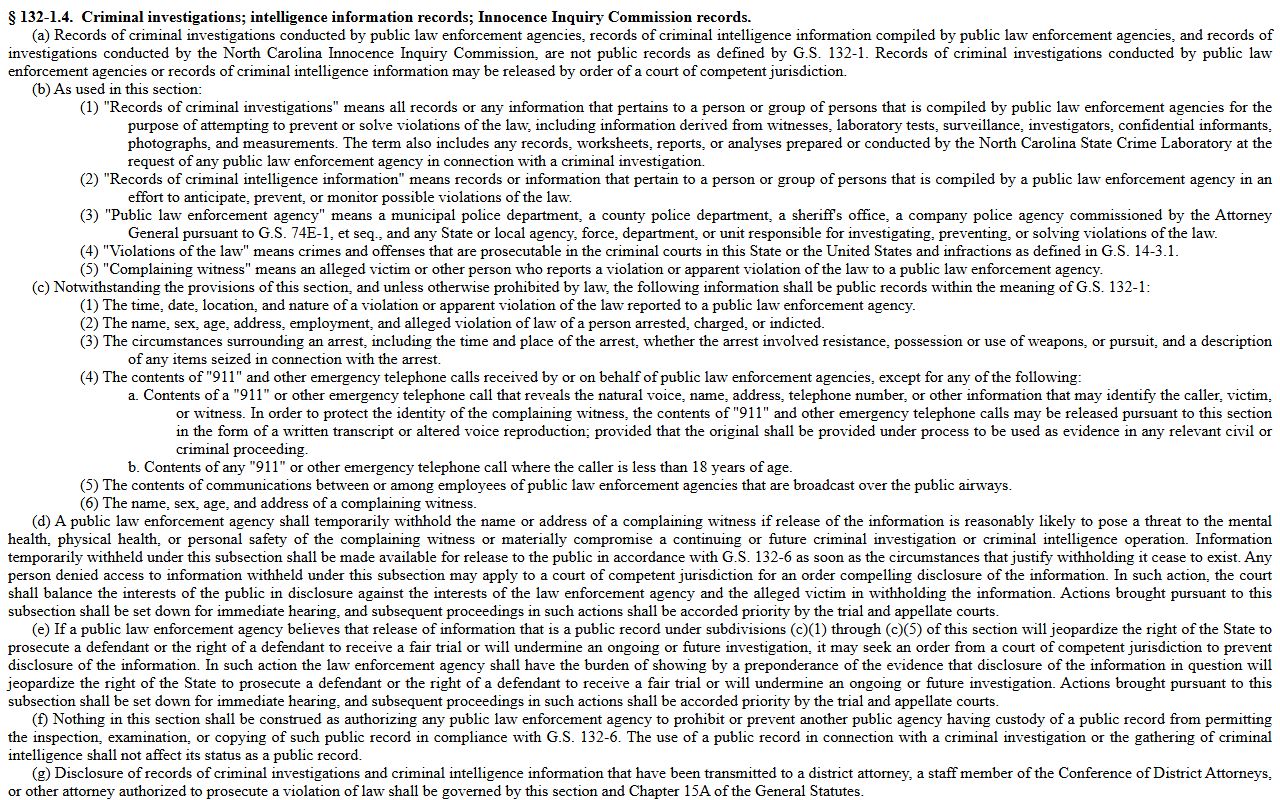
This statute source is relevant because a warrant search can cross from public court data into nonpublic investigation material.
State and Federal Warrant Checks
Some databases are not Pitt County warrant lists. NCIC and many federal warrant systems are law-enforcement systems, not public county search portals. The NCSBI sex offender registry is an official public registry for registered offenders in North Carolina, but it is not a general active-warrant database. The registry can still matter when a warrant issue is tied to registration status or a separate criminal case.
The assigned image source for this section is the NCSBI sex offender registry.
The registry example helps separate official statewide lookup tools from the broader warrant confirmation process.
Pitt County Warrant Records Requests
When online tools do not answer the question, use the correct public office. Judicial records should go through the Clerk of Superior Court and the eCourts Portal. Sheriff or county department records that are not posted online may be requested through the Pitt County public-records request page, subject to criminal-investigation limits and redaction rules.
For federal matters, public county tools are usually not enough. A federal arrest warrant, supervised-release violation, or U.S. Marshals matter must be checked through federal counsel or the proper federal agency. The research file includes federal Eastern District sources, but the manifest image for the U.S. Marshals page failed and no local image file was available.
The same separation applies to state prison and registry searches. The NCDAC offender search is for sentenced state prisoners, not active Pitt County warrants. The NCSBI registry is for registered sex offenders, not all people wanted by the court. Treat each official database as a narrow tool, then verify the court case or sheriff record through the office that controls it.
For court-process records, the case file is usually the best anchor because it can connect the missed hearing, bond condition, charge, or order to a specific Pitt County case number. For sheriff-held administrative records, the public-records request path may help only when the record is releasable and not part of a restricted investigation. If the matter may involve a sealed warrant, juvenile case, or federal hold, public county tools may show little or nothing.