
Pitt County Arrest Records and Court Charges
Pitt County arrest records start with the arrest and booking event. They may show that a person was taken into custody, booked at the Detention Center, listed with charges, assigned bond terms, or later released. The Pitt County Detainee Search states that it provides charge, sentence, and bond information for individuals currently detained, and that the information is refreshed hourly. That makes it useful for current custody checks, but it is not the full court file.
Court charge records are the formal accusations that move into the Clerk of Superior Court record. After arrest, the case may begin through a warrant, magistrate order, criminal summons, citation, indictment, or other charging document. Pitt County felony matters primarily move through Superior Court, while misdemeanors, infractions, and traffic matters generally begin in District Court. The full case outcome, plea, disposition, sentence, and later orders should be verified through the N.C. eCourts Portal or the Clerk of Superior Court.
The Pitt County Sheriff's Office is the law-enforcement source for custody and sheriff records. The Clerk of Superior Court is the judicial source for filed court records. The roles overlap in the arrest-to-charge window, so the best record search often uses both official channels.
How to Find Pitt County Arrest Records
For a recent arrest, start with the county jail and charge tools before reading the court case. The Pitt County Charge Inquiry states that it provides charge and bond information for people currently charged at the Detention Center. The page also uses a rolling date range, so it should be treated as a current or recent charge lookup, not a complete lifetime criminal-history database.
- Search the Charge Inquiry by full or partial name, or use a charge date range when the arrest date is known.
- Check the Detainee Search if the person may still be in custody or if booking number details are available.
- Search the eCourts Portal by defendant name, case number, citation number, county, and case type.
- Open the court case and compare the charge list, bond entries, hearing dates, and current status.
- Contact the Clerk of Superior Court for certified copies or older records not shown online.
The jail tools answer a different question than the court file. A jail result can help identify booking and bond facts, while the court record shows what was filed, amended, dismissed, pleaded, tried, or sentenced. For custody-only details, the related Pitt County inmate records page follows the jail roster more closely.
The official Pitt County Charge Inquiry appears in the manifest screenshot set. The source page is the Pitt County Charge Inquiry application.
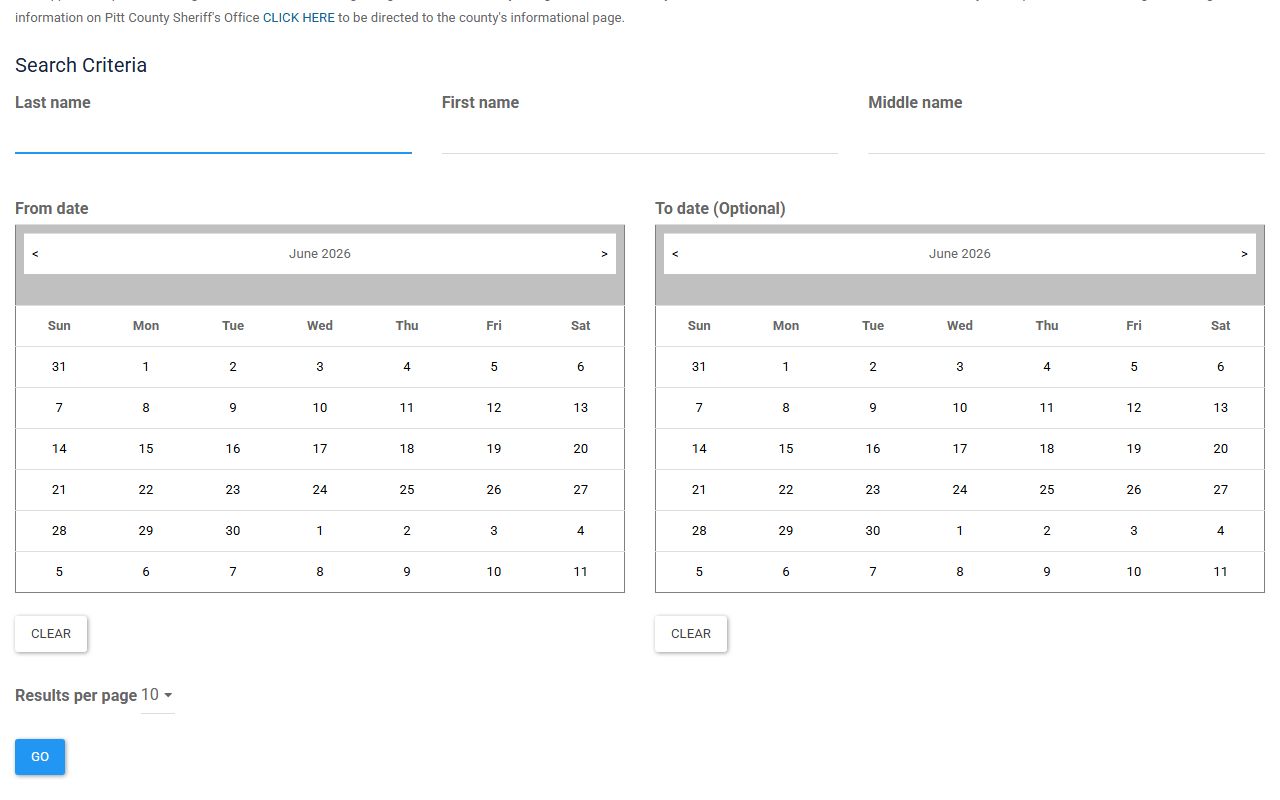
This image supports the charge-search section because the county app is the official local lookup for current and recent Detention Center charge and bond data.
Pitt County Charge Inquiry Fields
The charge application accepts several search fields, and none should be treated as a court disposition. The research file notes that the Charge Inquiry was showing a recent rolling range on June 17, 2026, from May 18, 2026 through June 17, 2026. That date-range design matters because it limits what the public app can confirm.
| Field Label | Type | Required | Options / Format Notes |
|---|---|---|---|
| Last name | Text | Optional | Maximum length 40; full or partial name search may be used. |
| First name | Text | Optional | Maximum length 40. |
| Middle name | Text | Optional | Maximum length 15. |
| From date | Date/calendar | Optional | Useful when the charge date is known. |
| To date | Date/calendar | Optional | Can narrow a recent rolling range. |
| Results per page | Dropdown | Optional | Options include 5, 10, 15, 20, and 25 results. |
Use the result to gather names, charge descriptions, bond information, and custody context. Then verify the filed case in eCourts or with the clerk before relying on the information for court dates, pleas, final disposition, or sentencing.
The date range is also a warning about timing. A charge may appear in the county app before the full court case is easy to find in the Portal, especially close to arrest, booking, magistrate review, or bond setting. If the case later moves to Superior Court by indictment or is changed by the District Attorney, the court file is the better source for the current charge status.
Pitt County Charges After Arrest
Charges after arrest can reach the court record in several ways. A magistrate may issue criminal process after probable cause review, an officer may write a citation for certain offenses, or felony prosecution may proceed through indictment. The District Attorney screens and prosecutes criminal charges, while the Clerk of Superior Court maintains the filed record.
| Document | Who Uses It | What It Does | Pitt County Context |
|---|---|---|---|
| Criminal complaint or warrant process | Law enforcement and magistrate | Starts or supports criminal process based on probable cause. | Often tied to arrest, custody, bond, or first appearance records. |
| Information or prosecutor filing | District Attorney | States the charge the State chooses to prosecute. | May reflect screening, amendment, or dismissal decisions. |
| Indictment | Grand jury | Accuses a defendant of felony conduct for Superior Court prosecution. | Common in felony paths handled by Superior Court. |
The formal charge is only one part of the criminal case file. Motions, pleas, hearings, dispositions, judgments, probation terms, and appeal notices belong to the wider Pitt County criminal court records file.
Pitt County Charge Status Terms
A charge can change after the first booking entry. The District Attorney may amend the allegation, reduce it, dismiss it, or proceed to plea or trial. A court entry may also show failure to appear, bond changes, compliance events, or sentencing. The status shown in an online result should be read as a point-in-time record, not as proof that no later order exists.
| Status | What It Means | Where to Verify |
|---|---|---|
| Pending | The charge or case has not reached final disposition. | eCourts Portal or Clerk of Superior Court. |
| Amended or reduced | The charge changed from the original allegation. | Filed court entries and prosecutor filings. |
| Dismissed | The charge was not carried forward to conviction. | Court disposition entry. |
| Nolle prosequi | The State declines to prosecute that charge at that time. | Clerk record and prosecutor entry. |
| Convicted | A plea or finding resulted in guilt. | Judgment and sentencing record. |
Note: Online charge data may lag behind court action, especially after hearings, dismissals, bond changes, or clerk updates.
Pitt County Charges vs Convictions
A charge is an accusation. A conviction is a court outcome. Pitt County criminal records may show both, but they do not mean the same thing. A person can be arrested and charged, yet later have a charge dismissed, reduced, amended, or resolved without a conviction. Public users should read the disposition field before drawing any conclusion.
| Point | Charge | Conviction |
|---|---|---|
| Stage | Filed after arrest or court process begins. | Entered after a guilty plea, verdict, or finding. |
| Meaning | The State alleges an offense. | The court record reflects guilt on that count. |
| Where seen | Charge Inquiry, Detainee Search, eCourts, and clerk files. | Judgment, disposition, sentencing, and DMV reporting where applicable. |
| Record risk | May be pending, dismissed, or changed. | May carry sentence, fines, probation, or collateral effects. |
Public Access to Pitt County Charge Records
North Carolina law treats public records broadly, but court and law-enforcement records follow different rules. G.S. 7A-109 addresses records kept by clerks, dockets, indexes, and other court records. G.S. 132-1.4 gives criminal investigation records special treatment, so sheriff investigation files are not open in the same way as ordinary public records.
For county-held sheriff or department records that are not available in a public app, use the Pitt County public-records request channel. For filed judicial records, use the eCourts Portal or the Clerk of Superior Court at the Pitt County Courthouse. Certified copies, complete case files, and older paper records remain clerk functions.
Important: Do not use an arrest or charge lookup for credit, housing, employment, insurance, or any FCRA-regulated screening purpose.
Pitt County Sheriff's Office Source
The Sheriff's Office is an important local source for the arrest side of the record. Its official county page identifies the agency, while the public charge and detainee applications provide more specific lookup tools. The official Pitt County Sheriff's Office page is the source for the agency context shown here.
The Sheriff's Office source matters because court charges after arrest often begin with a law-enforcement event before the Clerk of Superior Court record is updated.
Restricted Pitt County Arrest Records
Not every arrest or charge record is public. Juvenile records are confidential under G.S. 7B-3000. Sealed and expunged records are also restricted, and Chapter 15A Article 5 controls expunction eligibility. Mental-health material, protected addresses, financial identifiers, and sensitive victim information may be redacted or withheld.
| Record Type | Public Access | Practical Route |
|---|---|---|
| Sealed record | Hidden from ordinary public access by law or order. | Party, counsel, or court order access may be required. |
| Expunged record | Removed from public access when granted by court order. | Use clerk or counsel for eligibility and order questions. |
| Juvenile record | Confidential under Chapter 7B. | Not a public lookup item. |
| Investigation file | Special law-enforcement limits apply. | Request through official records channels, subject to denial or redaction. |